 Start simple. Then add complexity where it makes your life easier.
I maintain this Hugo blog for general writing.
But I also needed something different inside my Rails app at NoraFoundry.dev — a way to publish position papers, technical notes, and architecture essays directly in the application.
Hugo’s great, but bolting a separate publishing stack alongside Rails for a handful of markdown documents felt like overkill.
So I built a small file-based publishing engine inside Rails.
Drop a markdown file in content/papers/. Deploy. It’s live.
/papers/keep-memory-structure-judgment
Markdown files. YAML frontmatter. No database records.
Something that did the job without friction.
Why File-Based Worked
Similar to Hugo, each paper is just:
content/papers/<slug>.md
With frontmatter:
---
title: "Your Paper Title"
deck: "Short summary"
slug: "your-paper-slug"
published_at: 2026-03-01
status: "canonical"
---
The Rails app reads files from disk, parses frontmatter, renders markdown via CommonMark, generates TOC automatically, and caches the rendered HTML.
The model loads directly from the filesystem:
# app/models/paper.rb
def load_from_file(path)
  content = File.read(path)
  return nil unless content.start_with?("---")

  parts = content.split(/^---\s*$/, 3)
  frontmatter = YAML.safe_load(parts[1], permitted_classes: [Date])

  new(
    title: frontmatter["title"],
    slug:  frontmatter["slug"],
    body:  parts[2].strip,
    file_path: path
  )
end
Figure 1: The Paper model reads markdown from disk and splits on YAML fences — no database involved.
The controller fetches rendered HTML from cache, falling back to the renderer on a miss. If Redis is unavailable, the page still renders:
# app/controllers/papers_controller.rb
def show
  @paper = Paper.find_by!(slug: params[:slug])
  @rendered =
    Rails.cache.fetch(@paper.cache_key, expires_in: 30.days) do
      MarkdownRenderer.new(@paper.body).render
    end
rescue Redis::BaseError => e
  Rails.logger.warn("[papers] cache bypassed: #{e.class}")
  @rendered = MarkdownRenderer.new(@paper.body).render
end
Figure 2: The production controller — cache hit skips rendering, cache miss stores the result, Redis failure falls through gracefully.
Split on --- fences, parse YAML, render with Commonmarker (Rust-based GFM), post-process headings and code highlighting with Nokogiri and Rouge. The rendered HTML is cached at the controller level via Rails.cache.fetch.
No CMS. No admin. No content database.
Version control is the publishing system.
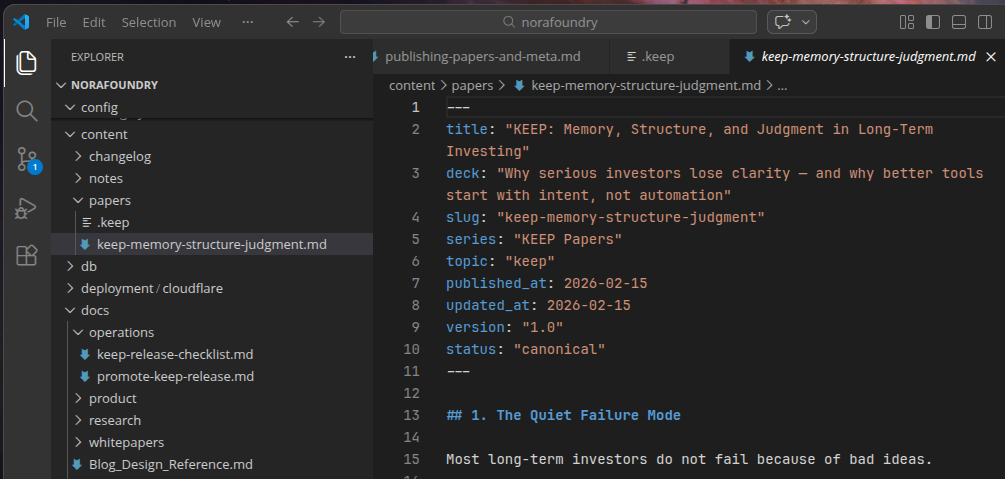
Figure 3: The entire publishing system — markdown files in a directory, managed by version control.
Starting Simple
In the beginning, I kept everything minimal.
SQLite. Solid Cache. Container-local storage.
It worked.
Caching used Solid Cache backed by SQLite. The SQLite database lived inside the container filesystem.
# config/environments/production.rb
config.action_controller.perform_caching = true
config.cache_store = :solid_cache_store
That’s it. Solid Cache backed by SQLite, living inside the container filesystem by default.
Which seemed fine.
The Deploy-Time Friction
In the first pass, caching lived inside the container using SQLite via Solid Cache. No extra infrastructure. No external services.
But during redeploys, the container filesystem was replaced. The solid_cache_entries table disappeared with it. The next request attempting to read a cached entry triggered a 500.
Content publishing was file-based and unaffected. Caching, however, was container-bound.
That lifecycle mismatch introduced fragility. Caching shouldn’t be able to interrupt content delivery.
The Decision: Persist or Externalize
At that point, there were two reasonable options.
Mount a persistent volume — keep SQLite, but mount a host directory so the database survives redeploys.
- Minimal change, no new infrastructure
- Cache lifecycle still tied to container topology
- Harder to inspect or manage externally
- Scaling beyond one container gets awkward
Externalize cache state with Redis — move caching to a dedicated instance on the LAN.
- Cache lifecycle fully independent of containers
- Centralized visibility and inspection
- Naturally supports multi-container scaling
- Adds a service and requires auth/network config
Mounting SQLite would have worked. I chose Redis because it made the separation explicit. Cache state became infrastructure-level, not container-level. And with a fail-open wrapper around Redis calls, a cache failure just means a slower page — not a broken one. SQLite inside the container couples cache state to container lifecycle in a way that complicates graceful failure.
Not a life-or-death choice, but one that makes life easier in small ways that compound over time.
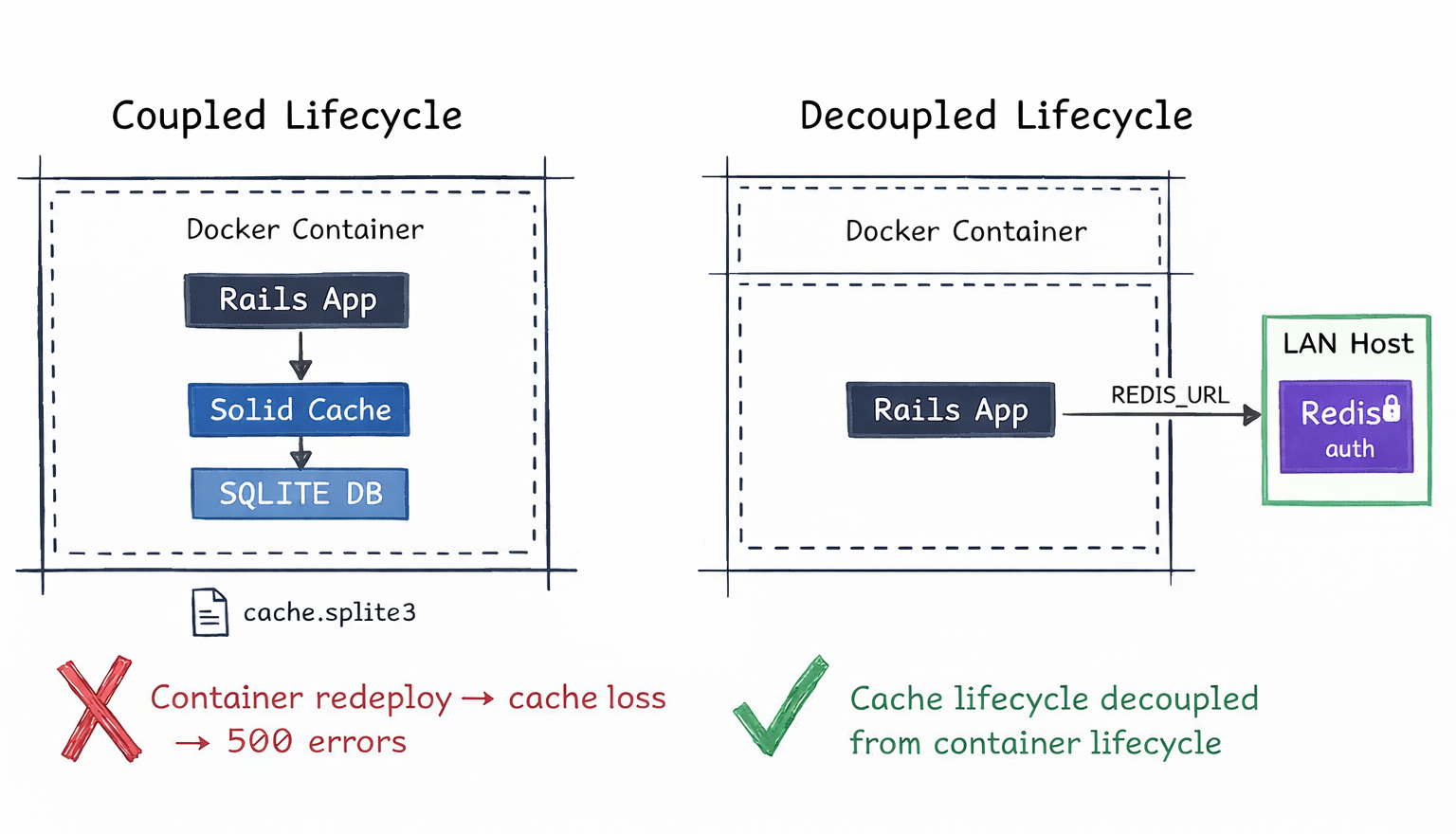
Figure 4: The core problem — SQLite cache coupled to the container lifecycle vs Redis decoupled on the LAN.
Redis in Practice
Production now uses:
config.cache_store = :redis_cache_store, {
  url: ENV.fetch("REDIS_URL"),
  connect_timeout: 0.5,
  read_timeout: 0.5,
  write_timeout: 0.5,
  reconnect_attempts: 2
}
What changed:
- Deploys stopped breaking cache reads
- Caching decoupled from the DB layer
- Cache state centralized outside containers
- Cache state became inspectable externally
TTL Discipline
Cache keys look like:
paper/<slug>-<mtime>
Cached with a 30-day TTL:
Rails.cache.fetch(@paper.cache_key, expires_in: 30.days) { ... }
The key is generated from the file’s mtime on disk:
# app/models/paper.rb
def cache_key
  mtime = file_path.present? ? File.mtime(file_path).to_i : 0
  "paper/#{slug}-#{mtime}"
end
Figure 5: Cache keys derived from file mtime — editing the markdown file on disk automatically busts the cache.
Which produces keys like:
paper/keep-memory-structure-judgment-1739644800
The mtime suffix means the cache auto-busts when the markdown file is edited — no manual invalidation needed. The expires_in: 30.days TTL is there to garbage-collect stale keys. If a slug changes, the old mtime-based key would linger in Redis forever without it.
Without TTL, Redis slowly fills with dead keys.
With TTL:
- Old keys self-expire
- Memory growth stays bounded
- No manual cleanup required
Making Cache Visible
I added a small log line around the cache boundary so cache hits and misses are explicit in production:

Figure 6: First request — cache miss triggers a write.

Figure 7: Subsequent request — cache hit, rendering skipped entirely.
Cache hits, writes, and misses are no longer invisible.
Fail-Open Semantics
Caching is an optimization, not a dependency.
As shown in Figure 2, the controller rescues Redis::BaseError and falls through to uncached rendering. If Redis is unavailable:
- Pages still render
- Cache is bypassed
- Users never see failure
The system degrades gracefully.
Securing Redis
Redis runs on a private LAN host, authenticated, protected-mode enabled, and injected into containers via deploy-time secrets. It is not internet-exposed. Redis is only reachable from application hosts on the private network.
# /etc/redis/redis.conf
bind 127.0.0.1 192.168.50.105 ::1
protected-mode yes
requirepass <REDACTED_STRONG_PASSWORD>
port 6379
Figure 9: Redis bound to localhost and private LAN only — not internet-exposed.
The connection string is stored as a deploy-time secret, never in clear config:
# deploy.yml
env:
  secret:
    - REDIS_URL
# .kamal/secrets (gitignored)
REDIS_URL=redis://:<REDACTED_PASSWORD>@192.168.50.105:6379/0
Infrastructure should default to secure.
What This Actually Was
This wasn’t really about Redis.
It was about:
- Eliminating a deploy-time failure mode
- Removing hidden coupling between cache and DB
- Introducing TTL discipline
- Adding observability
- Securing infrastructure properly
- Making caching fail-open
The publishing system stayed simple. Markdown files. Rails. Clean rendering.
But now it behaves like production software.
The Lesson
I started simple. SQLite and Solid Cache were fine at the start.
The right move wasn’t to over-engineer upfront.
It was to evolve when reality demanded it.
Start simple. Then evolve deliberately. Durable systems let you compound progress instead of chasing instability.
That’s how durable systems get built.