There’s always another rung on the ladder. Another opportunity. Another certification. Another title. Another person whose recognition or approval seems to matter.
And there’s nothing inherently wrong with any of those things. Recognition feels good. Accomplishments, especially those hard-earned, deserve to be celebrated. External feedback can be a valuable signal that we’re making progress.
But there’s a subtle trap when those signals become the motivation itself.
When we allow external validation to define our success, we become dependent on something we don’t fully control. There’s always another milestone to reach, another comparison to make, another person whose approval we might seek.
It can be an exhausting way to measure a life or a career.
For a while now, I’ve been working to internalize a different approach.
 Recognition hangs on the ladder, always one more rung away. Curiosity, craft, and an internal compass keep the work at the bench moving forward.
The Difference Between Recognition and Motivation
What if we measured our performance less by who recognizes our accomplishments and more by what we learn, what we build, how we grow, and who we become along the way?
Recognition is a nice carrot. It’s an encouraging signal that you’re making progress. But it doesn’t have to be what drives you.
For me, the deeper motivation comes from curiosity, a desire to make an impact, and the satisfaction of continually improving my craft.
I want to understand how things work. I want to challenge myself with new ideas and techniques. I want to build things that matter and help others do the same.
And importantly, these are choices I make intentionally, guided by goals I share with my team and my own sense of where I want to grow, rather than by someone else’s definition of the next rung on the ladder.
That distinction changes how we choose opportunities and how we experience both achievement and our journey.
A Personal Example: Learning Through the Practice of AI Engineering
At Improving, we’re challenged to go beyond simply understanding AI engineering concepts and demonstrate that we can apply them in working systems.
Our Stage 4 A.I. certification focuses on building reliable, multi-step agentic AI workflows. The challenge is to take individually validated AI tasks and orchestrate them into an end-to-end workflow that performs consistently and reliably.
That means implementing automated quality checks between steps, enforcing guardrails and human approval checkpoints, testing whether those safeguards can be bypassed, and instrumenting the workflow to trace failures and measure performance, token usage, and cost.
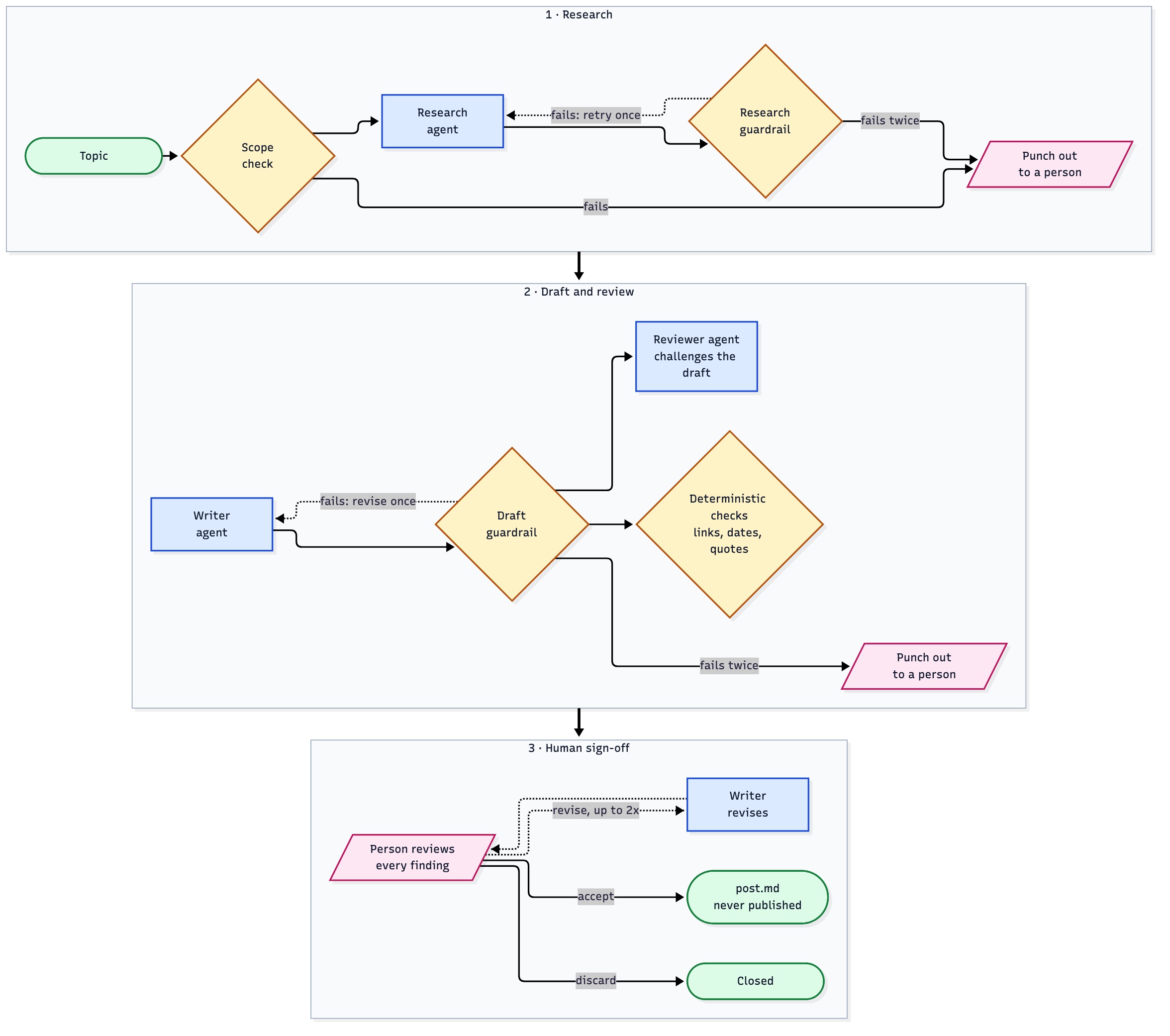 My Stage 4 workflow: research, draft and review, and human sign-off, with guardrails between steps and a handoff to a person when a check fails twice.
It’s a practical exercise in moving beyond AI prototypes toward systems that are reliable, measurable, and accountable.
I recently completed Stage 4, and the experience reinforced something I’ve come to appreciate about how I learn best: through hands-on challenges that push me to explore, experiment, and apply new concepts.
The certification provides a compelling goal to work toward and a welcome recognition of progress. But the real reward is developing and refining engineering techniques I can carry into more sophisticated AI workflows and real-world client challenges.
The certification marks your progress. The knowledge opens doors to what’s next.
The Freedom of an Internal Compass
There’s another benefit to pursuing goals from an internal sense of purpose: freedom.
When our motivation depends primarily on external recognition, we’re constantly looking outward for confirmation that we’re on the right path.
Did someone notice? Was the accomplishment impressive enough? Am I keeping up with others? Is there a more prestigious opportunity somewhere else?


Warren Buffett has often described this distinction as the difference between an Inner Scorecard and an Outer Scorecard—measuring success by our own values and standards rather than how others perceive us.
“The big question about how people behave is whether they’ve got an Inner Scorecard or an Outer Scorecard.” Warren Buffett, quoted in The Snowball (2008)
When we develop an internal compass, the questions we ask ourselves begin to change:
- Am I learning something meaningful?
- Am I becoming more capable?
- Am I contributing something valuable?
- Am I spending my time pursuing things that genuinely interest me?
- Am I building toward the kind of career and life I actually want?
These questions don’t eliminate ambition. They give it direction.
They also allow us to recognize something that’s easy to overlook in a culture that celebrates constant advancement:
Sometimes you’re already exactly where you want to be.
Not everyone needs the next title, the next company, or the next opportunity to feel successful.
You can value the people you work with, the freedom you have, the problems you’re solving, and the life you’ve built, while still challenging yourself to grow.
Success doesn’t always require moving somewhere else.
Sometimes it means going deeper into something you already love doing.
External Validation Looks Backward. Internal Motivation Pulls You Forward.
Recognition acknowledges something you’ve notched. Curiosity and purpose drive what you choose to accomplish next.
And unlike the endless pursuit of approval, that kind of ambition can coexist with contentment.
You can be completely satisfied with where you are today while remaining excited about what you might learn, build, and contribute tomorrow.
That’s a much more sustainable definition of success.
My Stage 4 A.I. certification is now behind me. I’m grateful for the experience and pleased to have reached a milestone that demonstrates the new techniques I’ve been developing the last 24 months.
But what excites me most isn’t having completed it, but taking what I’ve learned and applying it to the next generation of AI workflows, continuing to experiment, and discovering new ways to create value.
There will always be more milestones, certifications, and opportunities along the way.
I’ll welcome the external feedback that comes with them, but I don’t want to mistake that feedback for the reason I’m pursuing the work.
Whether it’s completing a milestone, earning a good grade, winning a competition, or getting kudos from a colleague you respect, it’s worth remembering that it is only a moment and it is the learning that compounds. Fulfillment for many of the reasons mentioned above comes from staying aware of this.